Power factor is one of the most overlooked indicators of electrical performance in agriculture, processing plants, and industrial facilities. Yet it plays a direct role in utility costs, equipment lifespan, and how much usable electrical capacity a facility actually has. The advantage for producers is clear: poor power factor is completely fixable, and the improvements often pay for themselves faster than most electrical upgrades.
Understanding Power Factor
Every electrical system relies on real power, reactive power, and apparent power. Real power performs the actual work such as running motors, heaters, and lighting, while reactive power does not create useful output but is required to energize magnetic fields in motors and transformers. Together they form apparent power, which is what utilities must supply to meet a facility’s full electrical demand.
Power factor is the ratio of real power to apparent power, and a higher value indicates more efficient energy use. A perfect score of 1.00 is ideal, while ratings below 0.90 lead to unnecessary costs and increased strain on electrical infrastructure. Facilities with motor-heavy processes, including conveyors, fans, compressors, pumps, and dust systems, naturally carry higher reactive loads and often see their power factor fall below utility thresholds. Even modern technologies like LED drivers and VFDs influence PF.
Why Low Power Factor Costs Money
Utilities size and bill their networks based on total kVA, not just the useful kW a plant relies on. When the power factor is low, more kVA is required to deliver the same amount of real work. This results in higher demand charges, additional surcharges, hotter-running electrical equipment, and reduced system reliability.
A simple example illustrates the impact. A plant needing 300 kW of real power at a power factor of 0.78 must draw roughly 385 kVA. Only 300 kW is doing productive work, while the remaining 85 kVA represents wasted capacity that still appears on the utility bill.
How Capacitor Banks Improve Power Factor
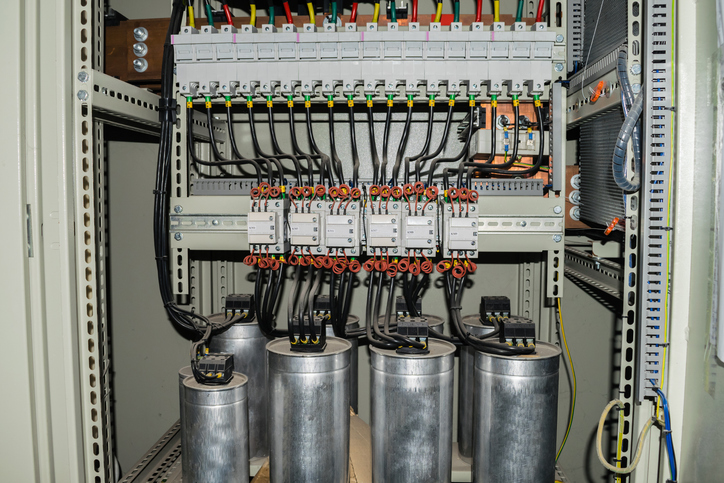
Capacitors counteract the lagging reactive power drawn by motors, bringing power factor closer to ideal levels. Properly applied banks reduce total kVA demand, stabilize voltage, extend equipment life, and free up electrical headroom for future expansion. Facilities can choose from fixed capacitor banks, automatic and multi-step systems, or harmonic-filtered banks for plants with significant VFD usage.